

Analysis
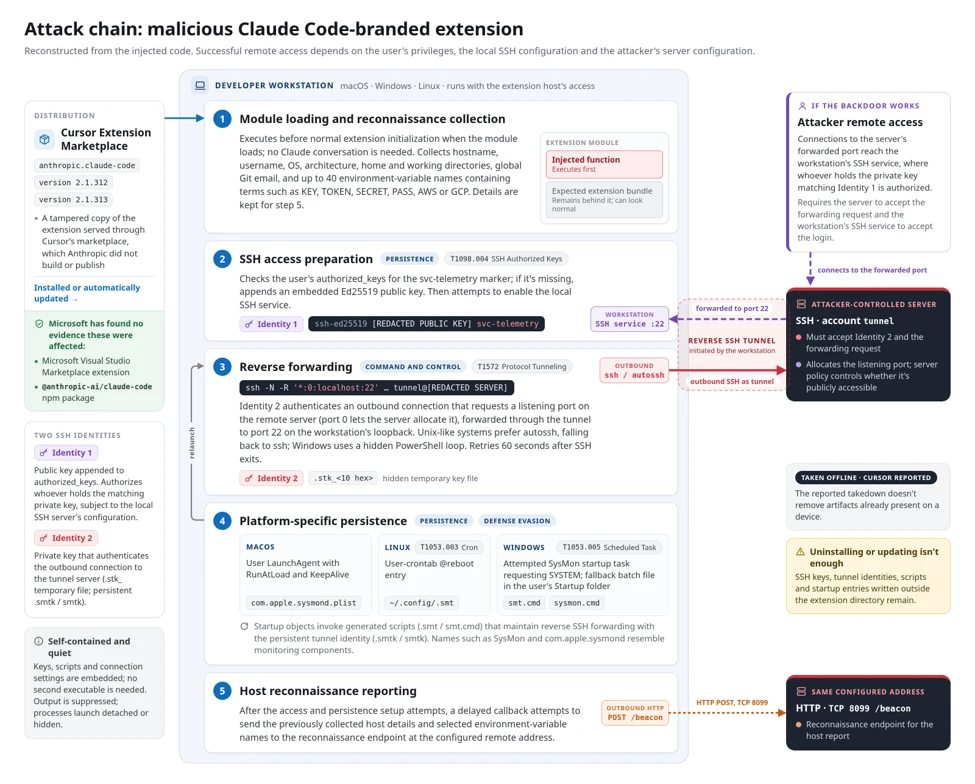
Microsoft’s October 30 investigation examines a malicious Claude Code-branded extension distributed through Cursor’s marketplace. The company says the affected packages were not distributed through Microsoft’s Visual Studio Marketplace or the official Claude Code npm package. Anthropic told Microsoft its systems were not compromised. That scope matters: a familiar product name does not establish the provenance of every package carrying it.
Microsoft describes injected code that attempted to add an SSH key, prepare remote access, establish a reverse tunnel and install startup persistence. Successful access depended on the host and server configuration. A failed connection did not necessarily mean the workstation was unchanged. The analysis also distinguishes collected environment-variable names from their values; those observations do not, by themselves, prove secret theft.
For a development team, the first useful question is which distribution path each machine actually used. A list of installed product names will not answer it. Version records, installation history and endpoint evidence can help separate a machine that received the package from one that merely uses the same editor or assistant. Preserving that distinction avoids both an unnecessarily broad response and an overly narrow assumption that ordinary functionality means safety.
The wider lesson is about recovery evidence. Removing an extension addresses the application package, but a sound investigation also checks changes made outside that package and follows the vendor’s current remediation guidance. Teams should be able to connect each finding to a specific device and document why it is considered resolved. Marketplace familiarity is useful context; a verifiable chain from publisher to installed artifact is the stronger basis for trust.
Source: Inside a malicious Claude Code-branded extension and its persistent SSH backdoor · 2026-10-30
Why it matters
Distribution provenance and persistent host changes determine the response more accurately than the product name.