

Analysis
What happens when you stop asking a language model to generate text and simply ask it to choose? That is the design behind Drex Max v1, whose repository was updated on Hugging Face on October 30. Described as a dense 27-billion parameter model (safetensors metadata lists 26B), it evaluates context and a typed question to return probabilities across answer options in a single forward pass.
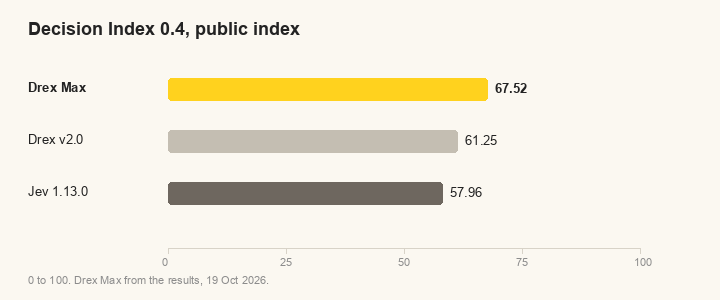
On vendor-reported metrics, Nace claims an advantage: a 67.52 score on the public text index of Decision Index 0.4, beating Drex v2.0 (61.25) and Jev 1.13.0 (57.96). But the harness is part of the result. Nace warns that reproducing these numbers requires its bundled loader's non-causal attention; standard causal chat runs do not reproduce them. Furthermore, the benchmark datasets are hosted under Nace's control, with no publisher named and no independent replication reported.
Here is what it does not tell us: getting better at the test and getting better at the job are separate experiments. Calling the release 'open-source' is also loose; these are open weights under a custom Open RAIL-M license that bars competitors and excludes commercial use for entities with over $1 million in revenue or funding. Hardware requirements are accessible—an affine Q4 version runs on a 24 GB Mac—but the base model backbone is unconfirmed on the card.
I'll be watching for independent evaluations outside Nace's harness to show whether single-pass probability scoring holds up on messy practical choices. Until someone replicates the numbers on held-out tasks, we have an elegant method, but not yet proof of a better tool.
Source: nace-ai/drex-max-v1 model card · 2026-10-30
Why it matters
Single-pass decision scoring could sharply lower compute costs for business routing, but only if the non-standard loader and restrictive commercial license can fit into existing production stacks.